

Skip to content
GrowthYari
Applications openSales & Communication Training

The GrowthYari Journey

Same classes.Same notes.Same certificates.But a different future.

Meet a student who did everything they were told to do. Attended every lecture. Submitted every assignment. Collected the certificate. And still froze in the interview.

“I knew the answer. I just couldn't say it out loud.”

That is where the journey changed.

  • Live coaching
  • Weekly practice
  • Personal feedback
  • No placement guarantee

Proof, not promises

The difference isn't another certificate. It's what you can prove.

Four stages, each one ending in something a stranger could evaluate. Not a completion badge — a piece of work.

  1. 01

    Learn

    Start from what you already know — your subject, your degree, your experience. We don't restart you from zero.

    You stop feeling behind.

  2. 02

    Practice

    Speak, write, pitch and explain — out loud, every week, with people who notice what you actually do.

    You stop freezing.

  3. 03

    Build

    Take on briefs with real constraints: a deadline, an audience, a limit. Produce work with edges, not filler.

    You stop guessing.

  4. 04

    Demonstrate

    Leave with recordings, writing and decks — evidence someone else can evaluate, not just a certificate that says you attended.

    You can finally show it.

Your education gives you knowledge. What you do with that knowledge makes it visible.

The story above is an illustrative journey, not a documented case study of a named student.

Recognition

Sometimes the hardest part isn't learning. It's showing what you've learned.

  1. 01

    You understand the subject. Then someone asks you to explain it, out loud, and the words arrive in the wrong order.

    Knowing something and saying it clearly are separate skills. The second one only shows up under pressure, which is exactly where it matters.
  2. 02

    You have done real work. Your portfolio just doesn't say so.

    A list of projects tells a recruiter you were present. It doesn't tell them what you decided, what went wrong, or what you would do again.

  3. 03

    You want the next opportunity. You are not sure what to improve first.

    Without a clear signal about what isn't landing, effort gets spread evenly across everything — which is another way of saying it gets spread across nothing.

None of this means you lack ability. It usually means the missing piece is practice, feedback, or evidence — and all three can be built.

The gap

Knowing something and demonstrating it are two different skills.

Preparation and performance are not the same activity. One happens privately, where nobody can correct you. The other happens in front of someone, where the thing you didn't practise is the thing they notice.

  • Watching a lesson on how sales calls work

    Running a practice sales call and hearing where it lost the thread

  • Reading about what makes communication clear

    Delivering a presentation and getting notes on what landed

  • Finishing a project and marking it done

    Explaining the decisions and trade-offs behind it to someone who wasn't there

  • Writing a resume that describes your ability

    Demonstrating that ability in a room, so the resume becomes checkable

Both halves matter. GrowthYari spends its time on the right-hand side, because that is the half most people never get to rehearse.

The cycle

Turn your potential into something people can see.

Every week runs the same five steps. The repetition is the point: a skill that only makes sense once is a skill you will lose by the next interview.

  1. 01

    Learn

    A single idea or technique, explained live and in plain language — not a playlist to work through alone.

    Leaves behindYou know what the skill is and when to use it.

  2. 02

    Practise

    You use it out loud, in a scenario close to the real one. Watching someone else do it does not count here.

    Leaves behindA recording of you doing it, for the first time.

  3. 03

    Receive feedback

    Specific notes on what worked and what didn't — the sentence that wandered, the question that closed the conversation.

    Leaves behindA short, usable list of what to change.

  4. 04

    Execute

    You run it again with the notes applied, in a harder situation, until it holds up without a script.

    Leaves behindA second recording you can compare against the first.

  5. 05

    Build proof

    The finished work is filed: the call, the deck, the email, the interview. Week after week, it becomes a body of evidence.

    Leaves behindA portfolio piece you can show someone.

Proof of work

Not just what you learned. What you can now demonstrate.

Certificates describe. Recordings, documents and outcomes demonstrate. Each artefact below is something you build during the batch and keep afterwards.

Please noteGrowthYari does not publish learner recordings, decks or documents. Nothing shown or described on this site is a real person's work.

Completing an activity is not the same as demonstrating a skill.

Anyone can tick a box. What makes an artefact useful is that someone who wasn't there can look at it and form a view of what you can do.

Situations

You may recognise one of these.

These are written from patterns rather than from people, so no name or result appears here. If one of them sounds like your week, that is usually the useful signal.

  1. Illustrative situation

    "I built four projects in college. If someone asks me about one, I end up listing the files instead of explaining the idea."

    The student who has projects but struggles to explain them

    The difficulty
    The work exists, but the explanation was never rehearsed — so it comes out as a description of effort rather than a demonstration of ability.
    The skill
    Explaining a project as a series of decisions, not a list of features.
    The evidence
    A recorded walkthrough of one project, reviewed and re-recorded.
  2. Illustrative situation

    "I know the answer. The second they ask, my mind goes completely empty and I start with 'basically, so...'."

    The fresher who knows the answer but goes blank in an interview

    The difficulty
    The knowledge is fine; the retrieval under pressure is not. Without a structure to fall back on, nerves get to decide the shape of the answer.
    The skill
    A repeatable structure for any question, so the answer has somewhere to start.
    The evidence
    Mock-interview recordings with a written debrief, over several weeks.
  3. Illustrative situation

    "I have three years in operations. Every sales role asks for sales experience, and I cannot seem to explain why I'd be any good at it."

    The career switcher who can't make their experience legible

    The difficulty
    Transferable skill is invisible on paper. It has to be demonstrated in the language of the role you are moving into, not the one you are leaving.
    The skill
    Reframing what you already know in the terms the new role uses.
    The evidence
    A rewritten profile and resume, plus a short live pitch for the switch.
  4. Illustrative situation

    "In meetings I have the point, but by the time I've finished explaining it, everyone has moved on."

    The professional who wants to lead conversations with clarity

    The difficulty
    Seniority makes the cost of vagueness higher, not lower. A long, well-intentioned explanation is still a long explanation.
    The skill
    Leading with the conclusion and holding a room through structure.
    The evidence
    Recorded presentations with specific notes on pacing and structure.
  5. Illustrative situation

    "The product is good. The moment I have to sell it to someone who doesn't know me, I end up discounting and over-explaining."

    The entrepreneur who needs to sell more effectively

    The difficulty
    Selling your own idea feels personal, so pushback reads as rejection rather than as information — and the conversation loses its shape.
    The skill
    Running discovery instead of pitching, and asking for a clear next step.
    The evidence
    Discovery-call recordings and a follow-up sequence that gets replies.

Illustrative scenarios written to show how a situation maps to a skill. Not real participants, and not results claims.

Who it's for

Built for people who have something to show — and no clear way to show it.

The program is at its centre for students and freshers, because that is where the gap between knowing and demonstrating first becomes expensive. The same gap runs through everyone else here.

Students & freshers

You can do the work. Explaining it is the part that costs you.

Find Your Next Step

Coursework proves you completed something. Interviews and internships ask you to describe what you decided and why — a muscle most curricula never load.

Weekly practice on the specific sentences that fail under pressure, with recordings you can compare against week one.

  • Graduates

    The degree is finished. The explaining has not started.

    The first professional conversation you enter is usually with a stranger who has twenty other applicants and no reason to read between the lines.

    Structured interview practice, a resume rebuilt around decisions, and evidence a recruiter can actually look at.

  • Career switchers

    You have the experience. It is written in the wrong language.

    Transferable skill does not transfer by itself. It has to be restated in the vocabulary of the role you want, or it reads as unrelated.

    Reframing what you already know, and a short live pitch that makes the switch make sense to someone hiring for the new field.

  • Working professionals

    You know more than you can get across in a meeting.

    As seniority grows, so does the cost of a long explanation. The ability to lead a conversation becomes more valuable than the ability to contribute to one.

    Delivery practice with specific notes on structure and pacing, applied to the meetings you actually have.

  • Entrepreneurs

    You built it. Selling it is a different skill entirely.

    Your own product feels personal, so pushback reads as rejection rather than as information — and the conversation loses its shape.

    Discovery-led selling, objection handling, and follow-up writing that gets replies instead of silence.

Sales & Communication

Build the skills you need. Practise until they feel natural. Show what you can do.

The 12-Week Sales & Communication Pilot Batch is GrowthYari's flagship program for college students, graduates and freshers. It is practical training rather than a recorded course: you learn a skill, practise it in real scenarios, get feedback, and improve it. Over twelve weeks you build the confidence to speak clearly, present confidently and handle real conversations — and finish with evidence of your skills you can show.

12 weeksSales & communication

12-Week Sales & Communication Pilot Batch

A 12-week, practice-first program that builds the speaking, listening and conversation skills interviews, internships and first jobs actually ask for.

  • Practical, scenario-based training
  • Structured practice every week
  • Feedback and review
  • Conversation and presentation skills
  • Evidence of your skills, not just a certificate
Duration
12 weeks
Focus
Sales & communication
Format
Practical training
Outcome
Evidence of your skills

Application and assessment happen before any payment. Fees are discussed only after we confirm the batch is right for you.

The twelve weeks

Proposed weekly structure. Final sequence is confirmed with the batch.

Understand what makes a message land instead of being ignored.

  • Baseline speaking task, recorded for reference
  • Structure versus rambling — what listeners actually need
  • Clarity drill: cutting a message without losing the point

You leave withA 2-minute self-introduction you would be happy to give in an interview.

Answer or update in a clear shape, under pressure.

  • The three-point structure for any answer
  • Rebuilding a rambling answer into a clear one
  • Timed practice rounds with peer feedback

You leave withA structured oral answer, recorded and reviewed.

Listen to understand, not to reply.

  • Active-listening drill
  • Open versus closed questions
  • Paraphrasing to confirm understanding

You leave withA question set written for a real scenario you face.

Manage nerves, pace and voice.

  • Breathing and pacing practice
  • Filler-word audit on your own recording
  • Impromptu speaking round

You leave withA short rehearsed presentation clip.

Understand selling as helping, not pushing.

  • Needs versus features
  • Understanding buyer motivation
  • Roleplay with a partner

You leave withA set of discovery questions for a real product or service.

Open a conversation from nothing.

  • The 15-second opener
  • Handling the first objection
  • Practice calls with feedback

You leave withA cold-call script and a practice recording.

Uncover what someone actually needs.

  • Question laddering
  • Note-taking during a live conversation
  • Live roleplays

You leave withA discovery-call recording with a written summary.

Respond to pushback without folding.

  • Mapping the common objections
  • The acknowledge–clarify–respond model
  • Objection drills

You leave withA personal objection-response playbook.

Hold attention and make a point stick.

  • Story structure for a business point
  • Slide basics and what to cut
  • A short pitch, delivered live

You leave withA 3-minute presentation.

Move a conversation to a clear next step.

  • Writing a follow-up email that gets a reply
  • Making the ask
  • Negotiation basics

You leave withA follow-up email and a closing script.

Apply the skills where they matter most.

  • Mock interviews
  • Giving a meeting update
  • A feedback conversation

You leave withA mock-interview recording.

Demonstrate the full skill set end to end.

  • A complete practice scenario
  • Self-review against your week-1 baseline
  • Final feedback session

You leave withA final recorded conversation and a reviewed body of work.

Ten skills you will practise

  • Clear speech
  • Structured thinking
  • Active listening
  • Asking good questions
  • Confident delivery
  • Presentation skills
  • Handling objections
  • Persuasion
  • Professional writing
  • Interview communication

What the Career Assessment Call is

A short conversation about where you are today, what you want to move toward, and whether this batch is the right way to get there. It is not a test and it is not a sales call. If we do not think the program can genuinely move you, we will say so.

The difference

Less passive learning. More deliberate practice.

There is nothing wrong with watching a good lesson. Most of us need one before we can do anything useful. The problem is that a lesson ends where the useful part starts — the doing, the being corrected, and the doing it again.

Necessary. Not sufficient.

Passive preparation

  • You watch someone do it well
  • You understand the theory
  • You take notes you will not reopen
  • You finish the course
  • Nobody sees you do any of it
Where the skill actually changes.

Deliberate practice

  • You do it out loud, badly, on purpose
  • Someone tells you the specific thing that didn't work
  • You change exactly that, and only that
  • You do it again, in a harder situation
  • It leaves behind something you can show

Both halves have a place. Only one of them produces evidence.

GrowthYari is built entirely around the right-hand column, because that is the half people rarely get to rehearse — and the half that decides what happens in the room.

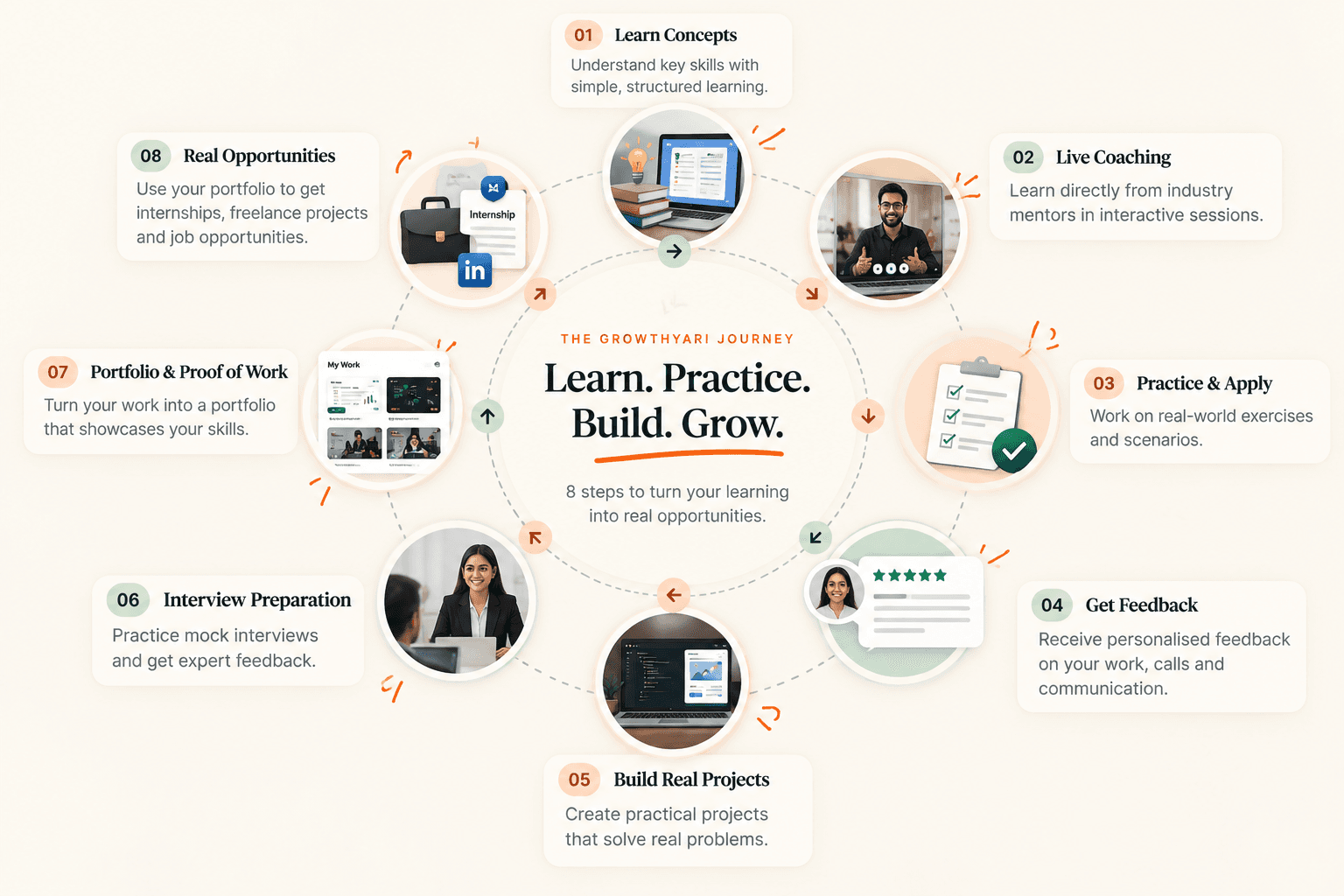
How joining works

What actually happens after you apply.

Eight steps, in order. The first four happen before any payment, and applying does not commit you to anything — or guarantee you a place.

  1. 01

    Apply

    Before payment

    Share your background and what you want to move toward. A short form — not a checkout, and nothing is charged.

  2. 02

    Career Assessment Call

    Before payment

    A short conversation about where you are today and what you want to get to. Not a test, and not a sales call.

  3. 03

    Confirm the fit

    Before payment

    Together we decide whether this batch is the right way to get there. If it isn't, we will say so at this point rather than twelve weeks in.

  4. 04

    Confirm your place

    Before payment

    Only if it is a fit do you confirm your place and arrange payment. Fees are discussed at this stage, never before.

  5. 05

    Begin live training

    Weekly live sessions with a working practitioner, in a group small enough that you cannot hide.

  6. 06

    Practise and get feedback

    Roleplays, drills and reviews every week, with specific notes on what to change rather than a score.

  7. 07

    Build your proof-of-work

    Recordings, decks, emails and interviews accumulate into a portfolio someone who wasn't there can read.

  8. 08

    Prepare for the opportunity

    Interview readiness, so that when the conversation you wanted arrives, it is not the first time you have had it.

What applying does not do

Applying does not guarantee admission, an interview, a job or a placement. It starts a conversation. The batch prepares you for the opportunities you go after — it does not produce them for you.

FAQ

Questions people actually ask.

Still unsure? Apply and use the short assessment conversation to ask us anything — there is no charge for it and no obligation afterwards.

Find Your Next Step

What we do not claim

No guaranteed job, placement or interview. No fabricated success stories, and no fake urgency. If the batch cannot help you, the assessment call is where we say so.

College students, recent graduates and freshers who want to speak clearly and handle real conversations — in interviews, presentations, client calls and first jobs.

No. The batch starts from fundamentals and builds up through practice. You are never expected to arrive already good at it.

It runs for 12 weeks, with one week dedicated to each core skill and a final capstone week.

Through the registration portal. It is a short application — not a payment. We review it and invite suitable applicants to an assessment conversation.

We review your application and background, then invite you to a short assessment conversation to make sure the batch is right for you. Nothing is charged and no seat is confirmed online.

Yes — but the more useful outcome is the evidence you build during the batch: recordings, written work and a clear before-and-after against your starting point.

Applying is free. Fees are discussed only after the Career Assessment Call, once we have confirmed the batch is the right fit for you. Payment happens after selection — never before.

No, and we will not claim otherwise. What the batch does is build the skills and the evidence — recordings, written work, interview practice — that make you a stronger candidate. The opportunities you pursue are still yours to go after.

Live, practical and small-group. You practise out loud in real scenarios and get direct feedback on what to change, rather than working through recorded lectures on your own.

The exact weekly commitment will be confirmed with you before the batch begins. It is built to sit alongside your studies or a job, but it does require regular practice.
Applications open

Your next opportunity deserves more than a better-looking resume.

Start by understanding where you are today, what you want to achieve, and which skills will help you move forward. The first step is a conversation, not a payment.