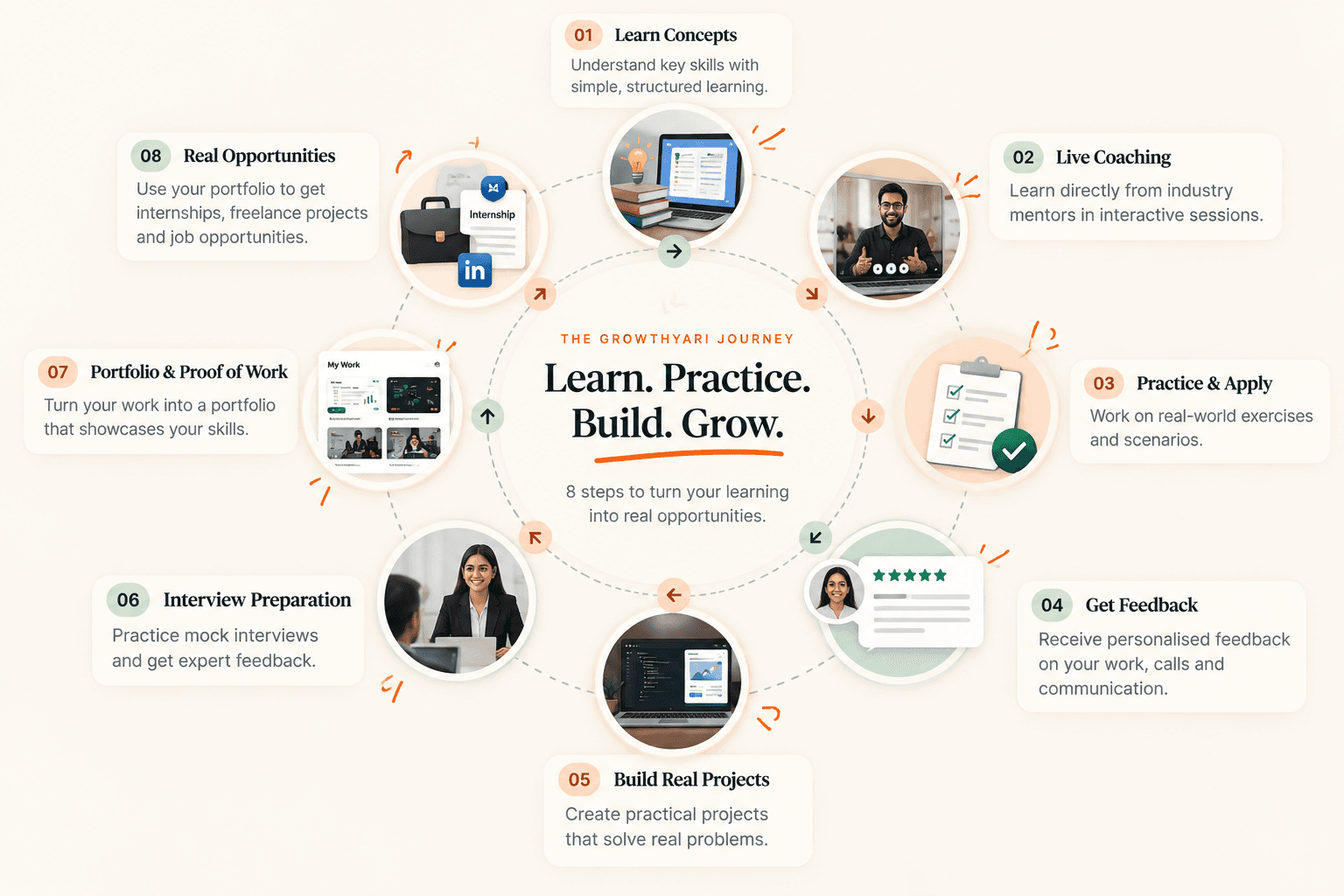
The 12-Week Sales & Communication Pilot Batch is GrowthYari's flagship program for college students, graduates and freshers. It is practical training rather than a recorded course: you learn a skill, practise it in real scenarios, get feedback, and improve it. Over twelve weeks you build the confidence to speak clearly, present confidently and handle real conversations — and finish with evidence of your skills you can show.
Duration
12 weeks
Focus
Sales & communication
Format
Practical training
Outcome
Evidence of your skills
Sales & Communication
Practical skills, practised out loud.
A 12-week, practice-first program that builds the speaking, listening and conversation skills interviews, internships and first jobs actually ask for.
A short conversation about where you are today, what you want to move toward, and whether this batch is the right way to get there. It is not a test and it is not a sales call. If we do not think the program can genuinely move you, we will say so.
Application and assessment happen before any payment.
Full curriculum
The twelve weeks, in the open.
Each week has one objective, a set of practice activities and a concrete output you keep. This is the proposed sequence for the pilot.
Every module is confirmed as deliverable before the batch begins. If any week changes, you will know before you commit.
WEEK 01
Foundations of clear communication
Objective
Understand what makes a message land instead of being ignored.
Activities
Baseline speaking task, recorded for reference
Structure versus rambling — what listeners actually need
Clarity drill: cutting a message without losing the point
You leave with
A 2-minute self-introduction you would be happy to give in an interview.
WEEK 02
Structuring any message
Objective
Answer or update in a clear shape, under pressure.
Activities
The three-point structure for any answer
Rebuilding a rambling answer into a clear one
Timed practice rounds with peer feedback
You leave with
A structured oral answer, recorded and reviewed.
WEEK 03
Listening and questioning
Objective
Listen to understand, not to reply.
Activities
Active-listening drill
Open versus closed questions
Paraphrasing to confirm understanding
You leave with
A question set written for a real scenario you face.
WEEK 04
Speaking with confidence
Objective
Manage nerves, pace and voice.
Activities
Breathing and pacing practice
Filler-word audit on your own recording
Impromptu speaking round
You leave with
A short rehearsed presentation clip.
WEEK 05
The sales conversation mindset
Objective
Understand selling as helping, not pushing.
Activities
Needs versus features
Understanding buyer motivation
Roleplay with a partner
You leave with
A set of discovery questions for a real product or service.
WEEK 06
Cold outreach essentials
Objective
Open a conversation from nothing.
Activities
The 15-second opener
Handling the first objection
Practice calls with feedback
You leave with
A cold-call script and a practice recording.
WEEK 07
Discovery conversations
Objective
Uncover what someone actually needs.
Activities
Question laddering
Note-taking during a live conversation
Live roleplays
You leave with
A discovery-call recording with a written summary.
WEEK 08
Handling objections
Objective
Respond to pushback without folding.
Activities
Mapping the common objections
The acknowledge–clarify–respond model
Objection drills
You leave with
A personal objection-response playbook.
WEEK 09
Presenting and storytelling
Objective
Hold attention and make a point stick.
Activities
Story structure for a business point
Slide basics and what to cut
A short pitch, delivered live
You leave with
A 3-minute presentation.
WEEK 10
Follow-up and closing
Objective
Move a conversation to a clear next step.
Activities
Writing a follow-up email that gets a reply
Making the ask
Negotiation basics
You leave with
A follow-up email and a closing script.
WEEK 11
Interview and workplace communication
Objective
Apply the skills where they matter most.
Activities
Mock interviews
Giving a meeting update
A feedback conversation
You leave with
A mock-interview recording.
WEEK 12
Capstone: putting it together
Objective
Demonstrate the full skill set end to end.
Activities
A complete practice scenario
Self-review against your week-1 baseline
Final feedback session
You leave with
A final recorded conversation and a reviewed body of work.
Ten skills you will practise
Clear speech
Structured thinking
Active listening
Asking good questions
Confident delivery
Presentation skills
Handling objections
Persuasion
Professional writing
Interview communication
Who it's for
Built for people who have something to show — and no clear way to show it.
The program is at its centre for students and freshers, because that is where the gap between knowing and demonstrating first becomes expensive. The same gap runs through everyone else here.
Students & freshers
You can do the work. Explaining it is the part that costs you.
Coursework proves you completed something. Interviews and internships ask you to describe what you decided and why — a muscle most curricula never load.
Weekly practice on the specific sentences that fail under pressure, with recordings you can compare against week one.
Graduates
The degree is finished. The explaining has not started.
The first professional conversation you enter is usually with a stranger who has twenty other applicants and no reason to read between the lines.
Structured interview practice, a resume rebuilt around decisions, and evidence a recruiter can actually look at.
Career switchers
You have the experience. It is written in the wrong language.
Transferable skill does not transfer by itself. It has to be restated in the vocabulary of the role you want, or it reads as unrelated.
Reframing what you already know, and a short live pitch that makes the switch make sense to someone hiring for the new field.
Working professionals
You know more than you can get across in a meeting.
As seniority grows, so does the cost of a long explanation. The ability to lead a conversation becomes more valuable than the ability to contribute to one.
Delivery practice with specific notes on structure and pacing, applied to the meetings you actually have.
Entrepreneurs
You built it. Selling it is a different skill entirely.
Your own product feels personal, so pushback reads as rejection rather than as information — and the conversation loses its shape.
Discovery-led selling, objection handling, and follow-up writing that gets replies instead of silence.
Proof of work
Not just what you learned. What you can now demonstrate.
Certificates describe. Recordings, documents and outcomes demonstrate. Each artefact below is something you build during the batch and keep afterwards.
Please noteGrowthYari does not publish learner recordings, decks or documents. Nothing shown or described on this site is a real person's work.
Illustrative. The shape of the work you build during the batch, not a real learner's artefacts.
Completing an activity is not the same as demonstrating a skill.
Anyone can tick a box. What makes an artefact useful is that someone who wasn't there can look at it and form a view of what you can do.
FAQ
Questions people actually ask.
Still unsure? Apply and use the short assessment conversation to ask us anything — there is no charge for it and no obligation afterwards.
No guaranteed job, placement or interview. No fabricated success stories, and no fake urgency. If the batch cannot help you, the assessment call is where we say so.
College students, recent graduates and freshers who want to speak clearly and handle real conversations — in interviews, presentations, client calls and first jobs.
No. The batch starts from fundamentals and builds up through practice. You are never expected to arrive already good at it.
It runs for 12 weeks, with one week dedicated to each core skill and a final capstone week.
Through the registration portal. It is a short application — not a payment. We review it and invite suitable applicants to an assessment conversation.
We review your application and background, then invite you to a short assessment conversation to make sure the batch is right for you. Nothing is charged and no seat is confirmed online.
Yes — but the more useful outcome is the evidence you build during the batch: recordings, written work and a clear before-and-after against your starting point.
Applying is free. Fees are discussed only after the Career Assessment Call, once we have confirmed the batch is the right fit for you. Payment happens after selection — never before.
No, and we will not claim otherwise. What the batch does is build the skills and the evidence — recordings, written work, interview practice — that make you a stronger candidate. The opportunities you pursue are still yours to go after.
Live, practical and small-group. You practise out loud in real scenarios and get direct feedback on what to change, rather than working through recorded lectures on your own.
The exact weekly commitment will be confirmed with you before the batch begins. It is built to sit alongside your studies or a job, but it does require regular practice.
Applications open
Your next opportunity deserves more than a better-looking resume.
Start by understanding where you are today, what you want to achieve, and which skills will help you move forward. The first step is a conversation, not a payment.